


1. Properly sizing the required power capacity
The first step before choosing a three-phase UPS is to carefully assess how much power the equipment you plan to connect actually consumes, because if you fall short, the UPS will fail when you need it most, and if you oversize too much, you will have spent money in vain.
To properly size the power capacity you need, you must take into account:
- Peak power demand and inrush currents: some equipment draws a much bigger surge of power when switched on than during normal operation. The UPS must be ready to withstand that initial surge without going down.
- Non-linear loads: modern equipment (such as computers, servers or power supplies) does not draw electricity steadily, but in small “pulses”. This places greater demands on the UPS and must be taken into account so it does not fail.
- Future demand: do you plan to connect more machinery to the UPS in the short or medium term? If so, leave margin and plan for it from the outset; it is better than having to buy another UPS before long.
- Real power versus apparent power (kW and kVA): sometimes the total power handled by a UPS and the actual active power required by your equipment are not completely equal; they can increase or decrease depending on the power factor (that is, according to equipment efficiency). That is why you must check the limits in the technical specifications carefully to avoid making a mistake.
2. Choosing the right electrical configuration
The UPS architecture must align with the technical requirements of the installation and the equipment to be protected. This means weighing up one of these two options:
- Three-phase to three-phase (3:3): for supplying three-phase loads, common in industrial processes and critical infrastructures.
- Three-phase to single-phase (3:1): when the available power supply is three-phase, but the loads to be protected are single-phase, for example, standard servers or small office systems.
Therefore, it is important to check the voltage, number of phases and technical characteristics of the loads beforehand to ensure that the UPS configuration meets the exact needs of the installation.
3. Defining the required backup runtime
How long must the installation remain operational if the mains fails? The answer can range from a few minutes to cover a brief interruption or allow a controlled shutdown, to several hours to maintain a critical service.
Backup runtime depends on the active power of the loads and the capacity of the batteries. It is also advisable to consider battery ageing, operating temperature and maintenance requirements.
If a standby generator is present, its compatibility with the UPS must be checked and the transfer between power sources properly sized.
4. Assessing availability and maintenance
In critical installations, preventing power outages is not enough; it also matters what happens if a component fails or maintenance work needs to be carried out.
Modular systems can facilitate expansions and certain redundancy configurations. However, redundancy must be sized so that the remaining power after a fault still covers the critical loads.
Monitoring, communications, bypass and access conditions for proper maintenance must also be evaluated.
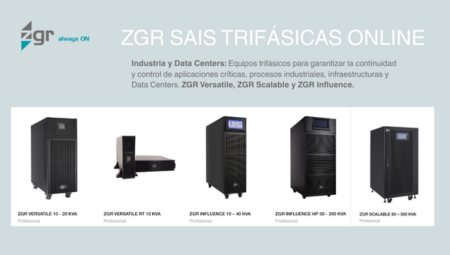
5. Which three-phase UPS from ZGR should you choose?
ZGR offers several families of online three-phase UPS systems tailored to different power, architecture and installation format requirements:
- ZGR VERSATILE (10–20 kVA): Tower-format unit with flexibility for single-phase and three-phase-to-single-phase (3:1) configurations. It is designed for installations with a three-phase mains supply that feed single-phase loads.
- ZGR VERSATILE RT (10 kVA): Versatile solution in a convertible Rack / Tower (RT) format of 10 kVA. It is ideal for communications racks or server rooms where a three-phase input needs to be adapted to a single-phase output while optimising cabinet space.
- ZGR INFLUENCE (10–40 kVA): Online three-phase-to-three-phase (3:3) UPS in a compact tower format, designed for light industrial environments and infrastructures requiring continuous three-phase power.
- ZGR INFLUENCE HP (50–200 kVA): High-power three-phase (3:3) range with a power factor of 1.0, dual input and parallel integration of up to four units for critical installations.
- ZGR SCALABLE (60–300 kVA): High-power modular system that allows capacity to grow in modules and configure redundancy schemes for infrastructures of maximum criticality.
Thus, when choosing a three-phase UPS, power alone does not determine the right unit. It is essential to check the current datasheets, the physical format available (Tower vs. Rack) and the specific backup runtime requirements.
6. ZGR, engineering and technical service throughout the entire UPS lifecycle
As a manufacturer specialising in power electronics, ZGR aims to help its customers find the most suitable solution to ensure the operational continuity of their equipment. Its engineers can travel to sites to carry out audits, analyse real needs and design customised solutions.
This support covers the entire equipment lifecycle: from initial advice and sizing to installation, commissioning, preventive and corrective maintenance, and retrofit services, to extend its service life and adapt it to new needs. In this way, ZGR combines technical expertise, bespoke solutions and its own after-sales service to support the customer over the long term.
It provides this support for all types of customers, from industrial companies and their production and/or maintenance teams to professional installers, electrical distributors or EPCs, adapting solutions and services in each case.
7. Three-phase UPS or another power quality solution?
Not all power disturbances require the same technology. If the problem is power outages, a three-phase UPS may be the right solution. However, if voltage sags cause motors or variable-speed drives to trip, it is also worth considering alternatives such as the ZGR AVC DVR dynamic voltage restorer.
The choice must start from diagnosing the disturbance and the affected loads.
Proven Experience in Critical Applications
Given its extensive experience and track record, ZGR has successfully installed online three-phase UPS systems across a wide range of sectors and companies, from hospitals to railway stations and communications, as well as industries, logistics centres, financial environments or retail. These projects illustrate the diversity of applications and the importance of adapting the solution to the requirements of each installation.
If you want to explore some examples of real-world success stories in greater detail, you can read the article: “UPS systems for critical sectors: successful installation case studies“.
Choosing an online three-phase UPS requires analysing multiple factors together, including power, electrical configuration, backup runtime and availability. Proper sizing makes it possible to protect critical loads and select a solution tailored to the real needs of each project.
Frequently asked questions about online three-phase UPS systems
What is an online three-phase UPS?
An online three-phase UPS is an uninterruptible power supply system that provides conditioned power to loads and maintains their supply during a mains failure, using the energy stored in the batteries.
What is the difference between a 3:3 UPS and a 3:1 UPS?
A 3:3 UPS has a three-phase input and a three-phase output. A 3:1 UPS has a three-phase input and a single-phase output. The choice depends on the electrical characteristics of the equipment to be protected.
How is UPS power calculated?
To properly size a three-phase UPS, you need to know the consumption of the equipment to be protected, expressed in kW and kVA, and check whether there are significant peak demands or inrush currents. Potential future expansions must also be taken into account. If this data is not available, the technical team can help analyse the needs of the installation and determine the right solution.
How much backup runtime does an industrial UPS need?
The backup runtime of a three-phase UPS for industrial environments depends on how long the loads must remain powered. A few minutes may be enough to cover a brief interruption, or backup for several hours may be required. Runtime must be calculated according to the load and battery capacity.
What is the difference between a monoblock UPS and a modular UPS?
A modular UPS allows power to be configured using modules and can facilitate expansions and certain redundancy architectures. Effective redundancy depends on the sizing and configuration of the system.
Can a three-phase UPS work with a standby generator?
Yes, provided there is compatibility between both units. Voltage, frequency, generator stability and operating conditions must be checked.
Which ZGR online three-phase UPS should I choose?
It depends on power, electrical configuration, backup runtime and the required availability. ZGR offers the VERSATILE, INFLUENCE, INFLUENCE HP and SCALABLE families. To select a specific model, it is necessary to match the needs of the installation against its technical specifications.
Can a UPS solve voltage sags?
It can protect certain loads against grid disturbances, but it is not always the most appropriate solution for voltage sags affecting motors and variable-speed drives. In those cases, it is advisable to study the disturbance and consider specific dynamic voltage compensation solutions.
Need help choosing a three-phase UPS for your installation?
ZGR’s engineering team can help you analyse the needs of your installation, size the solution and select the most suitable equipment. As a manufacturer specialising in power electronics, ZGR offers technical advice, installation, commissioning and service throughout the entire lifecycle of the UPS.
Contact ZGR to discuss your project.
Your energy, our challenge.
If you want to know more about us, you can also join our Community of power electronics enthusiasts on LinkedIn and subscribe to our newsletter.


