


The IEA highlights the need to increase investment in power grids
Global investment in electricity grids stood at approximately $400 billion in 2024 and increased to nearly $450 billion in 2025. The IEA forecasts approximately $550 billion in 2026, an increase of almost 20%, against a backdrop in which electricity already accounts for nearly 60% of global energy investment. The agency describes this as a rebalancing following years in which grid investment lagged behind investment in generation. However, it warns that investment remains below the level required and that part of the increase is attributable to rising transformer and cable costs
Greater investment in electricity grids means more projects involving network capacity upgrades, infrastructure modernization, and the construction of new substations and transformer stations. It also means a greater need for equipment capable of meeting these evolving requirements. Distribution system operators and EPC contractors will need to source suitable solutions from the market, leading to more procurement decisions involving technical specifications, tendering, and purchasing.
What does Spain’s electricity transmission network plan to 2030 include?
On September 16, 2026, the Spanish government announced its proposed plan for the development of the electricity transmission network through 2030. The proposal exceeds €17 billion, representing a 144% increase over the current plan and a 30% increase over the initial proposal. It includes 193 substations, more than 6,700 km of new transmission lines, and 8,164 km of lines to be uprated. Demand is the main driver of this new plan, accounting for 41% of the proposals received.
The proposal is still undergoing approval, and the final version may change the figures and timelines. However, the underlying pressure remains unchanged: growing demand, increasing renewable generation, and aging infrastructure.
To understand the implications, it is important to distinguish between two levels. At the first level, public planning determines which transmission network assets will be built. At the second, power grid modernization concerns how that plan is implemented at each substation and transformer station.
Responsibility for modernizing the power grid therefore falls to distribution system operators (DSOs), engineering firms, and EPC contractors. They will also need to adapt their networks to accommodate the 300 transmission bays planned to support new demand connected to the distribution network.
Building, upgrading, and digitalizing, the key elements of power grid modernization
Every power grid modernization project combines three main activities:
- Construction of new transmission lines and substations.
- Modernization and uprating of infrastructure that has been in service for decades.
- Digitalization of substations and transformer stations.
Each of these activities requires greater monitoring, remote control, and automation. As a result, more equipment depends on a power supply that must remain uninterrupted.
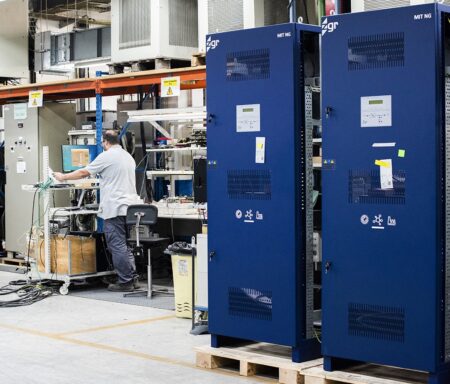
Auxiliary DC power supplies, the unseen but critical link in reliable power grid operation
Every additional sensor, digital relay, or remote-control device installed at a substation or transformer station introduces another load that must remain powered.
If the AC power supply fails because of an equipment fault, a voltage sag, or an outage, protection systems must continue to operate, control functions must remain available, and remote-control systems must continue reporting to the control center. This is the role of the auxiliary DC power supply.
La pieza clave de esa alimentación auxiliar es el rectificador-cargador, ya que convierte la electricidad de la red en la corriente continua que necesitan esos equipos y mantiene cargada un banco de baterías que sirve de respaldo si falla la red de alimentación AC. No es un simple cargador de baterías, ya que cuanto más inteligente y automatizada es una red, más crítica es su disponibilidad. Así pues, la fiabilidad de una subestación digital depende de la alimentación que la sostiene. Puedes profundizar en este tema en el artículo: Rectificadores-cargadores, el respaldo de seguridad para las redes eléctricas.
The key component of this auxiliary power system is the rectifier-charger. It converts AC power into the DC supply required by these devices and keeps the battery bank charged, ensuring backup power in the event of an AC supply failure. A rectifier-charger is much more than a simple battery charger. The greater the intelligence and automation of a power grid, the more critical equipment availability becomes. The reliability of a digital substation therefore depends on the power supply that keeps its essential systems operational. For more information, read our article: Rectifier-Chargers: critical backup power for electrical grid infrastructure.
What do EPC contractors and distribution system operators need to modernize power grids?
EPC contractors need equipment that integrates seamlessly into the specified system architecture, complies with technical requirements, and facilitates testing and commissioning, all within project schedules that leave little room for unforeseen delays.
Distribution system operators, meanwhile, seek a broad supplier base and prepare tenders to identify manufacturers with a proven track record, solutions that can be adapted to each installation, and support throughout the equipment’s service life.
For both groups, selecting a rectifier-charger involves more than specifying power ratings, AC/DC voltages, and backup time. Before defining the technical specification or issuing a tender, the following requirements should be clearly established:
- DC load voltage and power requirements.
- Battery technology and required autonomy.
- Communications and remote monitoring capabilities (web interface, Modbus, SNMP).
- Installation and environmental conditions.
- Ongoing technical support and maintenance.
- In-house engineering and innovation capabilities to develop custom equipment.
For further guidance, read Five questions to ask before selecting power electronics equipment.
How ZGR can support the modernization of substations, transformer stations, and medium-voltage networks
ZGR Corporación develops power conversion and secure power supply solutions. Its contribution to power grid modernization, including the modernization of substations and transformer stations, focuses on four key areas:
- New installations: Custom-manufactured equipment tailored to the specifications of each substation or transformer station, as well as to the actual installation conditions and battery characteristics, helping simplify testing and commissioning.
- Infrastructure upgrades: Solutions adapted to the actual operating conditions of each installation, enabling existing equipment to be replaced with ZGR solutions, backed by support throughout the equipment’s service life.
- Digitalization: Integrated monitoring and communications capabilities (web interface, Modbus, SNMP), with alarms via volt-free contacts.
- Distributed networks: Robust, flexible, reliable, high-performance, and energy-efficient equipment that is easy to install and maintain, enabling remote monitoring and control across more points in the network without a proportional increase in operational workload
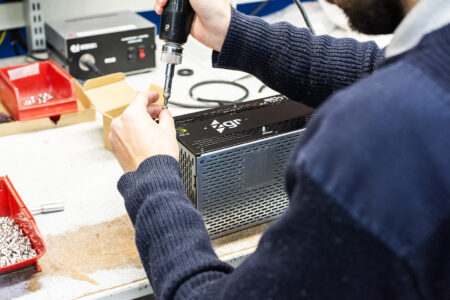
ZGR MIT NG, SWIT NG, and TPS NG, three solutions for three operating scenarios
These capabilities are delivered through three ranges of rectifier-chargers designed to maintain operational continuity even in the event of equipment or system failures.
- ZGR MIT NG: for demanding substation applications. Microprocessor-controlled thyristors, in single-phase and three-phase versions, with output voltages of 12, 24, 48, 110, 125, and 220 V. Up to two units can operate in parallel, making the range suitable for installations with heavy loads, with communications via Modbus RS485 and a web server.
- ZGR SWIT NG: Compact, efficient systems based on high-frequency technology. Available as modules for 19-inch racks or as complete systems, with output power ratings of up to 1,000 W and output voltages of 24, 48, 110, and 125 V, with high efficiency.
- ZGR TPS 120/200 NG: Designed for remote control in transformer stations and automated medium-voltage lines. These 48 V systems provide 120 W or 200 W of output power and support lead-acid, nickel-cadmium, and lithium batteries with capacities of up to 18 Ah. Features include automatic battery testing and remote management via Ethernet, web interface, SNMP, and Modbus TCP.
The final selection depends on the installation architecture, required backup autonomy, and project specifications. ZGR’s technical team works closely with each customer to assess their requirements and develop tailored, integrated solutions.
Support throughout the entire service life
Selecting the equipment is only the first step. With more than 20 years of experience serving leading distribution system operators, EPC contractors, and major industrial customers, ZGR supports every project throughout the installation’s service life, from initial engineering and solution definition through installation, commissioning, and ongoing maintenance.
ZGR defines the solution, manufactures it at its facility in Vitoria-Gasteiz, Spain, and provides installation, commissioning, and ongoing maintenance.
Frequently asked questions
What does ZGR contribute to power grid modernization?
ZGR supports power grid modernization by providing power conversion and secure power supply solutions, particularly rectifier-chargers for electrical infrastructure such as substations and transformer stations. These solutions are designed to maintain operational continuity in the event of equipment or system failures, with support extending from project definition through maintenance.
What is the difference between power grid planning and modernization?
Power grid planning defines which transmission network expansions and reinforcements are planned and when they are expected to take place. Power grid modernization concerns the implementation of these plans at individual installations through the construction, upgrading, uprating, and digitalization of substations and transformer stations.
What is a rectifier-charger, and what is it used for in a substation?
A rectifier-charger converts grid AC power into DC power to supply protection, control, remote-control, and communications equipment. It also maintains the charge of the battery bank that provides backup power if the AC supply fails.
Power grid modernization is an ongoing task. Reliability must be maintained just as continuously.
Nuestro compromiso es acompañar a cada compañía eléctrica y a cada EPC desde la definición del proyecto hasta el mantenimiento. ¿Modernizas una subestación o un centro de transformación, o preparas una licitación? Hablemos y estudiemos la solución más adecuada para tu proyecto.
Our commitment is to support every utility and EPC contractor from project definition through to ongoing maintenance. Are you modernizing a substation or transformer station, or preparing a tender? Contact us to discuss your project and identify the solution best suited to your requirements.
Tu energía, nuestro reto.
Your energy, our challenge.
Subscribe to our newsletter or join our community on LinkedIn.


