


This is where DC auxiliary power supply systems become particularly important, including the rectifier-chargers used in electrical infrastructure such as substations and transformer substations.
Why do electrical grids need to be modernized?
The power system is evolving from a model based primarily on unidirectional power flows towards a much more dynamic one, in which centralized and distributed generation, self-consumption, energy storage, electric vehicles, new industrial loads, and distributed energy resources coexist.
This transformation is increasing the need for grid capacity. In 2025, the Spanish National Commission of Markets and Competition (CNMC) reported that, during 2024, more than 60% of applications for grid access and connection from demand and storage facilities were denied, with approximately 40 GW of requested capacity being denied on the distribution grid due to insufficient capacity.
Modernization is not limited to building new lines and substations. It also involves making better use of existing infrastructure through digitalization, automation, and advanced management technologies.
The electrical grid of the future will therefore be more digital and automated. And the more it depends on electronic protection, control, and communication systems, the more important it becomes to ensure their power supply.
Four characteristics of the electrical grid of the future
Modernization can be summarized in four main objectives:
- A more distributed grid, capable of managing variable resources and power flows;
- A smarter grid, with greater sensor deployment, automation, and remote monitoring;
- A more efficient grid, enabled by monitoring and power electronics;
- A more resilient and secure grid, able to withstand extreme weather events and digitalization and cybersecurity risks.
What role do rectifier-chargers play in a substation?
In an electrical substation, many of the systems that protect, control, and operate the installation depend on a DC auxiliary power supply.
Protection systems, control and signaling equipment, remote control systems, automation systems, and certain communication systems need to have power available even when the auxiliary AC power supply is lost.
The DC power system provides this continuity through an architecture comprising, among other elements, rectifier-chargers, batteries, distribution equipment, and associated protection devices.
The rectifier-charger converts the incoming electrical power into the power required by the equipment to operate, while at the same time maintaining the battery at the required state of charge so that it can provide power when the AC supply is unavailable.
For this reason, it should not be regarded simply as a battery charger, but rather as one of the key elements of the auxiliary power supply architecture that ensures the availability of critical functions within the installation.
Rectifier-chargers are one of the key elements of the auxiliary power supply architecture, as they ensure the availability of critical functions within the installation.
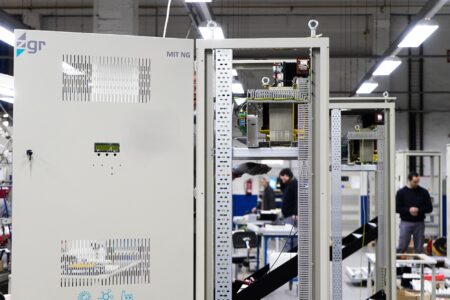
The greater the digitalization, the greater the demand for power quality
A modern substation incorporates an increasing number of electronic devices, automation systems, communication systems, and monitoring equipment. Therefore, to ensure that these functions remain operational, a reliable backup power source with sufficient capacity is required.
In the event of a loss of the auxiliary AC power supply, the battery provides backup power for the system’s specified autonomy period.
At the same time, the rectifier-charger ensures the proper power supply to DC equipment so that it can continue operating, while also ensuring appropriate battery management.
In other words, the smarter and more automated an electrical grid becomes, the more critical the availability of its DC auxiliary power supply system becomes.
What do distribution utilities, EPCs, and engineering companies need today?
In this new context, electric distribution utilities need reliable and adaptable solutions to modernize transformer substations and electrical substations, with efficient monitoring and maintenance.
Engineering companies and EPCs need equipment that can be integrated into specific architectures, meet technical specifications, and facilitate testing and commissioning.
In all cases, there is one common requirement: rectifier-chargers adapted to the actual characteristics of the installation.
ZGR solutions for different grid requirements
ZGR Corporación offers a range of rectifier-chargers for conventional electrical grids and Smart Grids, with different technologies and configurations.
The range includes solutions such as ZGR TPS 120, ZGR TPS 120/200 NG, ZGR SWIT NG, ZGR TELSIS APS, ZGR MIT NG, and ZGR MIT, designed to meet different DC auxiliary power supply requirements.
The choice of one solution over another depends on the installation architecture, voltage, power, autonomy, battery type, loads, monitoring requirements, and project specifications.
For this reason, selecting a rectifier-charger should not be limited to choosing a nominal power or voltage rating. Each installation has specific requirements and calls for an analysis of the auxiliary power supply, critical loads, battery, autonomy, and integration and maintenance requirements.
ZGR Corporación combines extensive experience in power electronics with technical support to adapt the solution to each project, from the design and manufacture of rectifier-chargers through to commissioning and ongoing technical support.
ZGR Corporación combines extensive experience in power electronics with technical support to adapt the solution to each project, from equipment design and manufacturing through to commissioning and ongoing technical support.
The modernization of electrical grids requires increasingly intelligent infrastructure. However, to ensure that these systems can protect, control, and operate the grid when they are needed most, a highly reliable, robust, flexible, and high-performance DC auxiliary power supply is also essential. Rectifier-chargers are a key component of this architecture.
Do you need to define or modernize the DC power supply system of a substation, transformer substation, or electrical infrastructure? Let’s discuss your requirements and find the most suitable solution for your installation.
Your energy, our challenge.
If you would like to learn more about our most innovative solutions or keep up to date with the latest developments in power electronics, subscribe to our newsletter and join our LinkedIn community.


