


If several solutions meet the technical requirements, what ultimately makes the difference? When a company is looking for a DVR to protect a production line against voltage sags, a rectifier-charger for an electrical substation, or a harmonic filter to improve power quality, the process usually starts in much the same way. The need is defined, performance specifications are compared, proposals are assessed, and the investment is evaluated. Up to this point, everything seems logical.
The problem arises when several solutions meet the technical requirements and the differences between equipment and quotations are minimal. At that point, other factors come into play.
One of these is technical service. When several manufacturers offer technically sound solutions, their ability to support the customer afterwards — both during installation and commissioning and throughout subsequent maintenance — can become one of the main decision-making criteria.
In sectors such as industry, electrical substations, hospitals, and rail transportation, manufacturers such as ZGR Corporación have seen how the experience accumulated by their technical service teams, their responsiveness, and their knowledge of the installed technology ultimately tip the balance by providing genuine added value.
The five questions to ask before purchasing a power electronics system are:
1. When a problem arises, who will respond?
A shutdown in an industrial facility, an incident at an electrical substation, or a failure in critical infrastructure rarely occurs at a convenient time. That is why it is worth asking who will be there when a problem arises.
A distributor? An external integrator? A remote support service located thousands of kilometers away? Or the manufacturer itself?
The difference may seem small when the equipment is new, but it becomes much more significant when an urgent diagnosis, a specific spare part, or a rapid intervention is required to restore operational continuity. It is at these times that responsiveness becomes an asset as important as the product itself.
2.Who really knows the installed technology?
Many incidents cannot be resolved simply by replacing a component. This is why there is a difficult-to-replicate advantage when the technical service team is part of the same organization that designs, manufactures, and continuously develops the equipment. Field service technicians do not work solely from manuals, and this knowledge often translates into direct benefits for the customer:
- More accurate diagnostics.
- Reduced downtime.
- More effective resolution of complex incidents.
This direct connection gives the customer a level of diagnostic and troubleshooting capability that is difficult to achieve when support depends on third parties with no involvement in the original product design.
3.What is being done today to prevent the next failure?
Most maintenance and production managers share the same philosophy: a planned intervention is always preferable to an unexpected shutdown.
That is why preventive maintenance provided by the equipment manufacturer’s technical service team has become one of the key differentiators in critical installations.
In power electronics, there are components subject to a well-known natural ageing process. Waiting for a critical component to reach the end of its service life is usually the most costly option. Not only can it result in an unplanned interruption, but, in certain scenarios, a failure can also cause additional damage to other components of the equipment.
4. What happens after commissioning?
“Commissioning an item of equipment should mark the beginning of a technical relationship, not the end of one,” says Odilo Alonso, Head of Technical Service at ZGR Corporación.
Power electronics equipment typically remains operational for many years. During this period, production requirements change, new regulatory requirements emerge, and demands for safety, connectivity, and cybersecurity increase. This is why more and more organizations value a manufacturer’s ability to support an installation throughout its entire lifecycle.
Aspects such as:
- Technical training.
- Remote monitoring.
- Preventive and corrective maintenance.
- Hardware and software updates.
- Availability of genuine spare parts.
- Specialized technical support.
- Equipment retrofit and modernization.
should not be overlooked during the equipment purchasing and negotiation process, because they become increasingly strategically important over the years. Fortunately, more and more companies are taking this into account.
5. Can a technician become a strategic partner for an installation?
Field service technicians (such as those at ZGR Corporación) accumulate experience across automotive manufacturing, hospitals, data centers, petrochemical facilities, railway networks, renewable energy plants, and electrical substations. They see hundreds of different installations, identify patterns, and become familiar with recurring problems.
An experienced technician can identify power quality issues, detect risks associated with voltage sags, locate harmonics affecting sensitive equipment, or propose improvements aimed at increasing the reliability and energy efficiency of an installation. Over time, a strong technical service team builds a high level of trust with its customers. You do not just save costs; you also gain peace of mind.
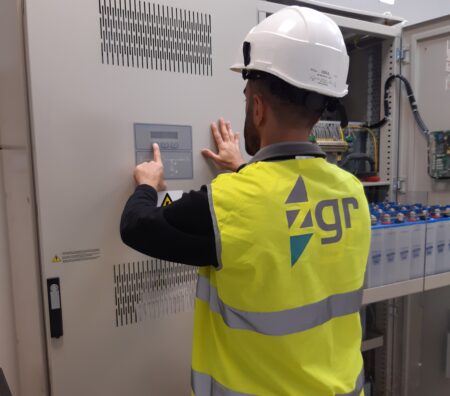
Technical support, the differentiator that rarely appears on a datasheet
When several pieces of equipment or solutions offer similar performance levels, the decision often shifts towards much more practical considerations:
- Who responds.
- Who knows the equipment inside out.
- Who has the right spare parts available.
- Who continues to support the installation years after commissioning.
Examples that illustrate the scope of ZGR Corporación’s technical service
With more than two decades of field experience, ZGR Corporación’s technical service professionals have had to resolve issues of all kinds. As a non-exhaustive summary, here are some examples of this work:
- Specialized technical training worldwide for Schneider Electric field technicians on DVR systems manufactured by ZGR Corporación.
- Technical support and maintenance at railway facilities associated with ADIF, RENFE, Metro de Barcelona (TMB), Alicante Tram, and Murcia Tram.
- Maintenance and support at photovoltaic plants, such as the 60 MW Kaixo plant in Mexico.
- Specialized technical support at wind farms, such as those at Jarreta and Carracha in Spain.
- Technical support at facilities and industrial sites of leading companies in the Automotive sector (Ford, Mercedes-Benz…), Electricity Distribution (Iberdrola, Unión Fenosa, Naturgy…), Food Distribution (Mercadona), and Healthcare and Consumer Industries (Abbott)….
- Ongoing collaboration with industrial engineering firms and installers (Cobra, Eiffage, Acciona…).
Because, ultimately, what an organization purchases is not merely a power electronics system, but a trusted partner in technology and innovation — one that proposes differentiated solutions and supports its equipment throughout its entire service life through ongoing development and field expertise.
That is how we see it at ZGR Corporación. Shall we talk?
Your energy is our challenge.
If you would like to learn more about our technical support success stories, innovations and developments, and, more broadly, stay up to date with the latest developments in the world of power electronics, you can subscribe to our newsletter and join our community on LinkedIn.


