


The weak link: the impact of voltage sags on Data Centers, HVAC systems, and the overheating paradox
In the management of critical infrastructure and data centers, the focus on uptime has traditionally centered on the power architecture supplying the racks. The usual assumption is that, as long as the Low Voltage UPS systems keep the server loads powered, data processing remains protected.
However, the electrical grid presents a silent threat that often goes unnoticed until a failure occurs: voltage sags in data centers can severely affect the HVAC system (HVAC/chillers) and the service life of the power equipment itself.
Voltage sags in Data Centers: the overheating paradox
Unlike a complete power outage, a voltage sag is a sudden and significant reduction in the magnitude of the supply voltage, which can reach 50% or 70% for several cycles or even seconds.
While the servers continue operating thanks to the UPS systems, sensitive control electronics, variable frequency drives, and protection systems for chiller compressors and heat exchangers detect the anomaly and trip as a protective measure.
The result is a critical scenario:
- Instantaneous loss of cooling flow: the cooling system shuts down.
- Zero thermal inertia: the extremely high power density of today’s server rooms causes the temperature to rise exponentially within seconds.
- Emergency shutdown: with no means of dissipating the heat, the data center is forced to shut down for thermal protection to prevent processor damage.
A redundant power architecture for the servers is of little use if the facility itself collapses due to overheating.
Cumulative stress on UPS systems and batteries
There is a second major economic and technical factor when voltage sags occur in data centers: the degradation of Low Voltage equipment.
Every time a disturbance or voltage sag occurs on the electrical network, the Low Voltage UPS systems are required to switch and absorb the event. Although they are designed to handle this, repeated battery-bank discharge and recharge cycles, combined with the thermal and electrical stress placed on power semiconductors, drastically reduce battery service life.
“Installing a DVR at the service entrance prevents the HVAC system from shutting down and prevents the UPS systems from repeatedly switching to battery mode, thereby extending battery life. However, when we are dealing with power levels of several megawatts, implementing the solution directly at Medium Voltage is what makes the difference: we avoid having to manage currents above 5,000 A at Low Voltage, radically simplifying the electrical infrastructure and busbars while reducing plant losses,” says Jon Ander Beistegui, Industry Business Development Director at Zigor Corporación.
Low Voltage or Medium Voltage? The advantage of operating at Medium Voltage
From a technical standpoint, installing a high-power DVR, such as a 3.6 MVA unit, at Low Voltage at the facility’s service entrance solves the disturbance problem on a global basis. However, when dealing with these power levels, implementing the solution at Medium Voltage offers decisive operational and infrastructure advantages:
-
Current and busbar management:
At 400 V (Low Voltage), a power level of 3.6 MVA means managing currents above 5,000 A. This requires large switchboards, massive busbars, and multiple cables per phase. At Medium Voltage, the current is drastically reduced, optimizing the equipment footprint and simplifying the electrical installation.
-
Reduction of energy losses:
Operating at higher voltage levels reduces I²R (Joule) losses in the transmission and internal distribution of power within the data center, positively affecting PUE.
-
Integrated protection at the service entrance:
Acting at the Medium Voltage switchgear allows the entire facility, including power transformers and internal lines, to be isolated before any conversion to Low Voltage, simplifying the overall architecture and maintenance.
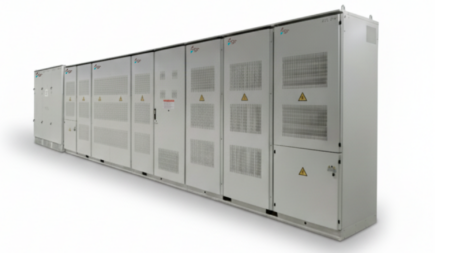
The solution: ZGR AVC DVR High Power
The ZGR AVC DVR High Power system acts as a centralized dynamic voltage restorer. Its operating principle is based on injecting the missing voltage in series with the grid within an ultra-fast response time (< 3 ms), using energy drawn directly from the grid without the need for battery storage.
Key benefits of Medium Voltage compensation with a DVR
- Total HVAC system continuity: Instantaneous voltage injection prevents VFDs and compressors from tripping, ensuring uninterrupted cooling of server rooms.
- Reduced stress on the UPS fleet: By stabilizing the voltage at the service entrance, downstream UPS systems remain in normal operating mode, without cycling their batteries, eliminating unnecessary stress cycles.
- Efficiency above 98% without batteries: Because chemical battery banks are not required, battery replacement costs are eliminated and PUE (Power Usage Effectiveness) is not penalized.
- High-power handling capability: Designed for power levels from 1 to 6 MVA (scalable in LV/MV) and suitable for integration into electrical rooms or outdoor containerized solutions.
Ensuring true uptime
The resilience of a data center is measured by the strength of its weakest link. Protecting servers while leaving HVAC systems exposed to disturbances on the electrical network is an unacceptable operational risk.
Ensuring voltage stability from Medium Voltage makes it possible to protect the facility’s thermal availability, simplify high-power electrical infrastructure, and maximize the data center’s long-term operating profitability.
Frequently asked questions about voltage sags in Data Centers
What is a voltage sag?
A voltage sag is a temporary reduction in the electrical supply voltage. Although it may be brief, it can affect sensitive equipment such as variable frequency drives, control systems, motors, and other components of a data center’s infrastructure.
How can voltage sags affect data centers?
Voltage sags in data centers can cause sensitive electrical equipment to trip and compromise critical auxiliary systems. In particular, if the HVAC system is affected, cooling can be interrupted, compromising the thermal conditions required in server rooms.
Do UPS systems protect against voltage sags?
UPS systems can provide protection against certain electrical disturbances, depending on their technology, configuration, and the characteristics of the installation. However, not all data center loads are necessarily connected to the same UPS systems. Therefore, protection of the HVAC infrastructure must be specifically assessed.
What is a DVR and what is it used for in a data center?
A DVR (Dynamic Voltage Restorer) is a power electronics system that dynamically compensates for voltage drops by injecting the voltage required to maintain the appropriate level on the protected network. In a data center, it can be used to protect sensitive loads against voltage sags and improve operational continuity.
Why install a DVR at Medium Voltage in a data center?
In multi-megawatt installations, operating at Medium Voltage makes it possible to manage much lower currents than at Low Voltage. This can simplify the electrical infrastructure, reduce the dimensions of busbars and conductors, and facilitate centralized protection of the installation.
What are the advantages of a battery-free DVR?
A DVR that uses the grid itself as its energy source for voltage compensation does not require a dedicated battery bank to perform this function. This can reduce the maintenance and replacement requirements associated with electrochemical energy storage, while also facilitating a high-power solution focused on power quality.
How can you assess whether a data center needs a DVR?
The first step is to analyze power quality and record the frequency, depth, and duration of voltage sags, as well as identify which loads are affected. This information can then be used to determine the required level of protection and whether it is more appropriate to operate at Low Voltage or Medium Voltage.
Ensure the power quality of your Data Center
Would you like to assess the power quality of your installation or analyze the integration of Medium Voltage DVR systems?
Contact our Engineering and Industry team at industria@zigor.com or visit our website to learn more about the ZGR AVC DVR range.
Our team of experts can provide the expertise and know-how required to address voltage sags in data centers, as well as offer an integrated solution tailored to the specific circumstances and challenges of your installation.
Si quieres saber más sobre nosotros, puedes suscribirte a nuestro y sumarte a nuestra Comunidad de apasionados por la electrónica de potencia en
To learn more about us, subscribe to our newsletter and join our community of power electronics enthusiasts on LinkedIn.
Your Energy, Our Challenge.


