

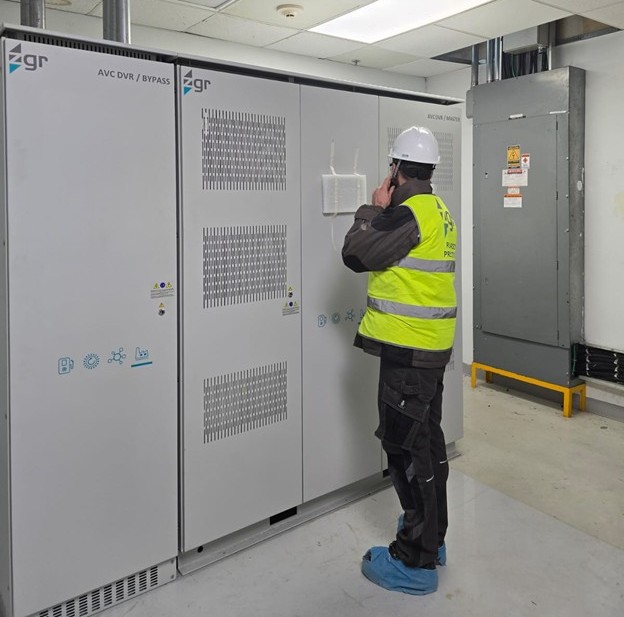
When an industrial company evaluates the purchase of a Dynamic Voltage Restorer (DVR), the focus is usually on the equipment itself: its technical specifications, response capability, and efficiency. This is logical. However, one question too often remains secondary: who will install it, commission it, and respond when something goes wrong?. The answer to that question is, in many cases, just as decisive for the final result as the reliability of the equipment itself. That is why ZGR provides a dedicated technical service for industrial DVRs.
DVR (Dynamic Voltage Restorer): the importance of proper commissioning
A DVR (Dynamic Voltage Restorer) is a power electronics device connected in series with the load that injects voltage in real time to compensate for power quality disturbances such as voltage sags, overvoltages, phase unbalance, and harmonic distortion. Unlike a conventional industrial UPS, it responds within milliseconds without interrupting the power supply and only operates when an actual disturbance occurs, making it a highly energy-efficient solution. In addition, it operates without batteries, significantly reducing maintenance costs and installation space requirements.
However, its technological complexity means that installation and commissioning must follow a strict technical procedure and leave no room for improvisation. Incorrect regulation parameter settings, inadequate configuration for the plant’s load profile, or improper integration with existing protection systems can compromise both equipment performance and overall installation safety. The best Dynamic Voltage Restorer on the market will perform below its capabilities if it is not installed by specialists who understand it in depth. No two loads are identical, and optimal performance is achieved only after parameter-by-parameter tuning of the equipment response to the specific characteristics of each installation.
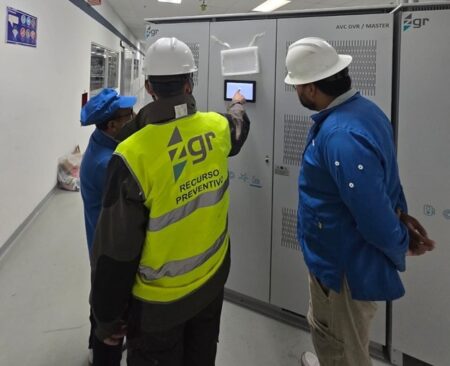
The case: 7 DVRs installed in a fully automated electrical equipment manufacturing plant
ZGR was selected to supply, install, and commission seven DVR units in an electronics manufacturing plant designed and operated under the highest automation standards. The units were distributed across critical load points within the facility, protecting the systems most sensitive to power quality disturbances.
The project included three clearly defined deliverables:
- Physical installation of the equipment
- Full technical commissioning with operational verification
- Training of the client’s maintenance personnel
Execution took place while the plant was not in active production, requiring maximum precision and efficiency. The available time window was limited, and any technical incident would have had a direct impact on the startup schedule.
How it was executed: four phases under a certified technical protocol
Phase 1 — PES protocol: complete technical inspection before energization
Before any of the seven units was energized, ZGR experts applied the commissioning protocol (PES) to each unit: verification of power and control wiring, inspection of critical components, and validation of all protection circuits. No unit is energized without a detailed technical verification.
Phase 2 — Full regulation testing
With the units energized in no-load condition, each DVR was verified to ensure correct output voltage regulation, compliance of response times with technical specifications, and proper operation of alarm, protection, and communication systems. All seven units passed the tests without any incidents.
Phase 3 — Live regulation demonstration
Once individual operation had been validated, a live demonstration was conducted with the DVRs connected to the facility’s actual electrical network. The client does not just receive a compliance report—they see firsthand how the equipment protects their installation under real conditions.
Phase 4 — Practical training of maintenance personnel
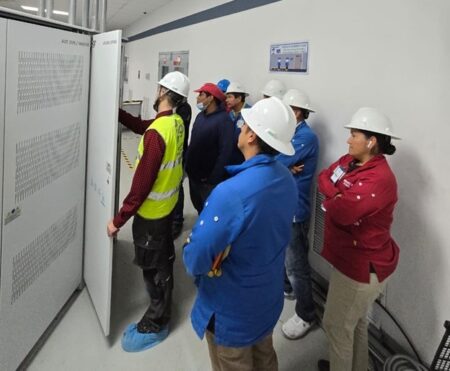
The client’s personnel, under the direct supervision of ZGR technicians, performed the essential operational procedures: transition to normal operating state and transition to bypass mode on the installed equipment. The result: a fully autonomous maintenance team from day one.
Why ZGR’s technical service is a differentiating value
In the industrial power protection market, it is common for the equipment supplier and the installation contractor to be different entities. The installer does not fully understand the equipment, the manufacturer does not fully understand the client’s installation, and the client ends up managing the friction between both parties.
ZGR operates under a different model. The same technical service team that installs industrial DVRs has in-depth knowledge of the internal design and control architecture of the Dynamic Voltage Restorer. This results in precise regulation adjustments, early problem detection, and far more effective and practical training. Beyond commissioning, the service covers the entire lifecycle: 24/7 preventive and corrective maintenance, permanent remote support, exclusive stock of original spare parts, continuous performance monitoring, and advisory services for redesign or retrofit at end of life. This model is applied with the same rigor across all sectors: food and beverage, pharmaceuticals, logistics, automotive, data infrastructure, and power generation and distribution. If the answers to key service-related questions are uncertain, the risk does not lie in the equipment. It lies in the service.
ZGR Corporación: design, engineering, manufacturing, and technical service for industrial DVRs
For more than 25 years, ZGR has been developing power quality solutions for major energy, industrial, logistics, and communications companies, with in-house design, engineering, and manufacturing capabilities. ZGR Maintenance and Services covers the entire equipment lifecycle: technical audit, commissioning, maintenance, 24/7 remote support, specialized training, and continuous monitoring. Companies such as Iberdrola, Acciona, Schneider Electric, Abbott, Mercadona, Cobra, Eiffage, and Serveo have relied on ZGR to protect their critical electrical installations.
At ZGR, your energy is our challenge. If electrical disturbances are negatively affecting your productivity, contact our technical team: we will provide a customized solution and a technical service for industrial DVRs tailored to your needs.
Frequently asked questions about Dynamic Voltage Restorers and their technical service
What does the commissioning service for a DVR include? Supervision or execution of the physical installation, PES protocol with full internal technical inspection, no-load regulation tests, live demonstration connected to the facility’s actual grid, and practical training of maintenance personnel.
Is it necessary to stop production to install a Dynamic Voltage Restorer? It depends on the electrical configuration and connection point. In many cases, installation can be carried out while the plant remains in operation, limiting the power interruption to a minimal time window. ZGR’s technical service team evaluates each case and always adapts to the client’s operational requirements.
What maintenance does a DVR require once installed? ZGR’s technical service for industrial DVRs recommends periodic preventive maintenance including calibration, component inspection, firmware updates, and parameter verification. In addition, continuous performance and status monitoring is provided to anticipate potential failures before they impact production.
Does ZGR keep original spare parts in stock for its DVR equipment? Yes. ZGR’s technical service for industrial DVRs maintains an exclusive stock of original spare parts, ensuring reduced repair times and eliminating dependence on international supply chains.
Does ZGR offer remote technical support for its Dynamic Voltage Restorers? Yes. ZGR provides 24/7 remote support with diagnostic and monitoring capabilities, allowing issues to be anticipated and technical queries to be resolved without the need for on-site intervention.
If you want to stay up to date with our latest developments, you can subscribe to our newsletter and join our LinkedIn community of professionals passionate about power electronics and efficient electrical energy management.


