

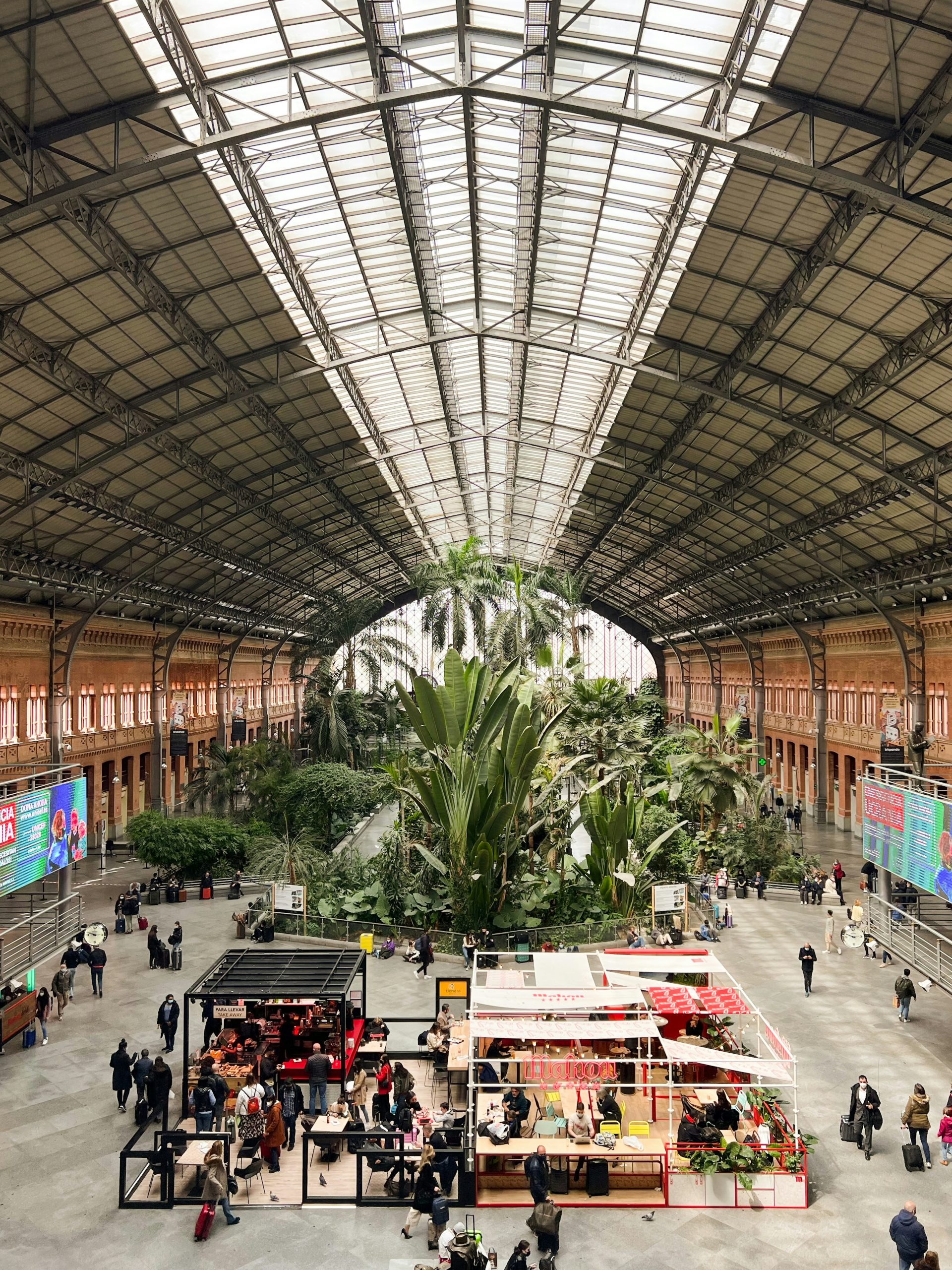
The real problem: grid voltage spikes can destroy railway control servers and other critical elements
High-voltage catenary lines, traction motors constantly starting and braking, and power converters distributed along the line all create a particularly harsh electrical environment for sensitive electronic equipment.
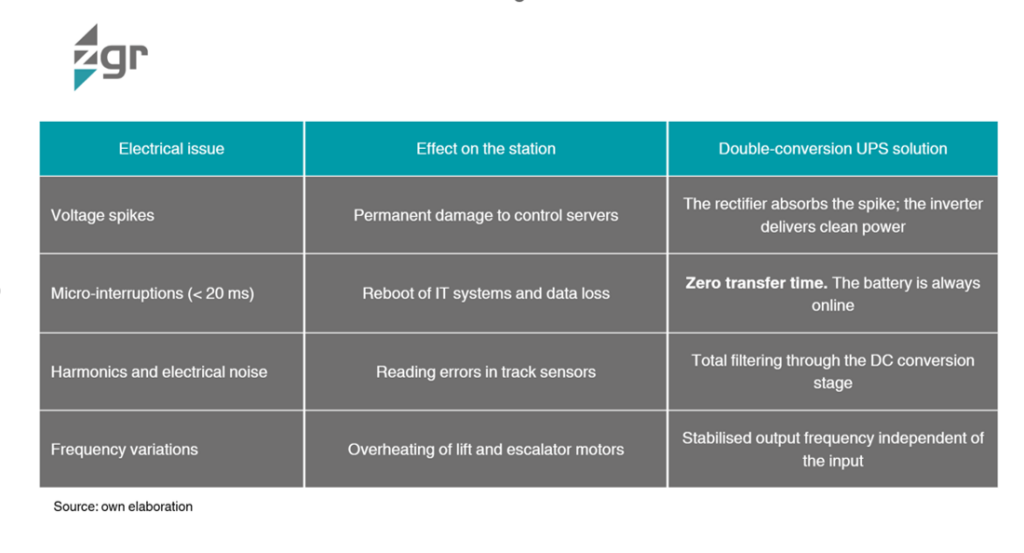
We are talking about voltage spikes capable of destroying control servers, harmonics that cause reading errors in track sensors, and frequency variations that overload escalator motors. And above all, we are talking about micro-interruptions. Those interruptions of less than 20 milliseconds that are imperceptible to the human eye but, for a railway interlocking system, result in an immediate reboot — and with it, an automatic emergency stop across the entire line.
An offline or line-interactive UPS topology cannot solve this problem. Double-conversion online UPS technology can.
How double-conversion online UPS works: zero transfer time in the event of a power outage
The principle is as simple as it is effective: the AC from the grid is rectified into DC and, from there, an inverter reconstructs it as a pure, perfectly stabilised sine wave before delivering it to the load. The battery is permanently connected in parallel with the DC bus, which means that the moment the grid fails — or simply degrades below acceptable parameters — the transition is instantaneous. Zero transfer time.
There is no switching. There is no moment of uncertainty that, in other topologies, can cause a reboot. The load remains completely unaffected.
Furthermore, since the energy delivered to the equipment always comes from the inverter — not directly from the grid — all power quality disturbances are eliminated during the DC conversion stage: spikes, sags, harmonics and frequency variations. What reaches the load is always clean, stable electrical power, decoupled from any external anomaly.
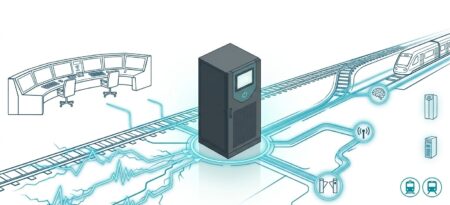
What double-conversion online UPS systems protect in a station: from signalling systems and communication networks to access control
A properly sized UPS must safeguard:
-
Signalling and track control systems
The brain of the operation. Any micro-interruption can desynchronise interlocking systems and trigger automatic emergency stops that collapse the operation of the entire line for minutes or hours. The cost of such an incident — in delays, passenger service and reputation — far exceeds any investment in electrical protection.
-
Communication netw
Fibre optic networks, TETRA radio systems and evacuation public address systems. If these networks fail during an emergency, passenger management becomes extremely complex and critical.
-
Ticketing and access control systems
Turnstiles and vending machines are particularly vulnerable to overvoltages. Their simultaneous failure creates chaos in passenger flow and forces manual access opening, with the operational and security costs this entails.
-
Emergency lighting and tunnel ventilation
Not sophisticated technology, but the systems that guarantee people’s physical safety in confined spaces during a grid failure. There is no margin here.
-
CCTV and security systems
Anti-terrorism and public safety video surveillance cannot afford interruptions. Control operators need continuous visibility of all station areas, especially in emergency situations.
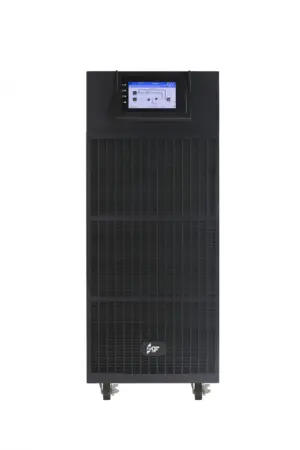
ZGR Influence HP 80-200 kVA
Single-phase or three-phase UPS: the choice depends on the architecture
There is no single answer. At ZGR Corporación, we work with both topologies because both have their place within the same station.
- Single-phase online UPS systems — such as the ZGR TOWER PRO range or ZGR EFFICIENT RT — are the natural solution for specific communication racks, point-of-sale terminals or small local data centres in smaller stations. Compact, easy to install and easy to maintain. Up to 10 kVA in a format that requires no additional infrastructure.
- Three-phase online UPS systems are the standard for the backbone infrastructure of a line. At this level, the scale and criticality change completely. ZGR INFLUENCE HP, available from 50 to 200 kVA with a power factor of 1.0 and 95.5% efficiency, is specifically designed for critical installations in transport, hospitals and data centres. Its three-level IGBT inverter architecture minimises conversion losses, and its dual input with independent bypass adds an additional layer of operational security that is essential in railway environments.
“What we usually find when entering a railway project is that the conversation about electrical protection comes too late. Signalling is designed, communications are planned, ventilation is calculated… and the quality of the power feeding all this is treated as a last-minute detail. We try to change that logic. A properly specified UPS from the very beginning of the project not only protects the investment: it drastically reduces corrective maintenance costs and extends the lifetime of all control electronics. The return is clear and fast,” says Jon Ander, Industry Director at ZGR Corporación.
What double-conversion topology solves, according to the identified electrical issue
Additional requirements: electromagnetic compatibility and resistance to vibration and temperature
In railway environments, UPS specification does not end with power rating and topology. Proximity to high-voltage traction lines imposes additional requirements that any project engineer must verify before selecting equipment:
- Electromagnetic compatibility (EMC). The electromagnetic fields generated by catenary lines can interfere with the UPS internal electronics if the equipment is not certified to operate in that environment. Applicable European standards — EN 50121 for railway applications — define the electromagnetic immunity and emission limits that the equipment must comply with.
- Resistance to vibration and temperature. UPS systems installed in technical rooms close to the tracks often withstand continuous mechanical vibrations and wider temperature ranges than standard office equipment. At ZGR Corporación, we have experience adapting our systems to these environments. This is part of what it means to work in critical infrastructure.
Safety, the best investment in transport infrastructure
The economic rationale for changing this mindset — from seeing protection as a maintenance cost to seeing it as a safety investment — is straightforward. A one-hour metro service interruption in a medium-sized city affects tens of thousands of passengers, entails incident management operational costs, possible contractual penalties and significant reputational impact. If that interruption originates from an electrical failure that a proper protection system could have prevented, the analysis becomes even harder to justify.
For this reason, investing in a properly sized double-conversion online UPS for a railway station is not simply another infrastructure cost; it is the guarantee of the 24/7 operational safety required in these environments.
The ZGR Corporación double-conversion online UPS range
ZGR Corporación offers a complete range of single-phase and three-phase double-conversion online UPS systems designed to meet the demands of the most critical environments:
-
ZGR TOWER PRO 1-10 kVA
Single-phase online tower format for localised loads.
-
ZGR EFFICIENT RT 1-10 kVA
Compact single-phase online UPS for 19” communication racks.
-
ZGR VERSATILE 10-20 kVA
Available in adaptable single-phase and three-phase configuration for intermediate loads.
-
ZGR INFLUENCE 10-40 kVA
Three-phase online UPS for medium-sized station infrastructure.
-
ZGR INFLUENCE HP 50-200 kVA
High-power three-phase online UPS with 95.5% efficiency and native paralleling up to 4 units. The standard for control centres and railway backbone infrastructure.
For critical infrastructure projects where the technical specification requires detailed analysis, our engineering team is available to support the process from initial sizing through to commissioning.
The initial technical audit is free of charge and will provide you with a valuable starting point.
You can also stay up to date with the latest developments in power electronics by subscribing to our newsletter and joining our LinkedIn community of power electronics enthusiasts.


