


Anyone with years of experience managing operations or maintenance in a cosmetic plant knows the feeling: the line is running normally, parameters are within range, operators are working in rhythm… and suddenly, something stops. There is no blackout. The lights did not go out. It was a millisecond-scale disturbance in the electrical supply. Invisible to people, devastating for advanced automation and robotics.
This is not an exceptional phenomenon. Plants located at the end of a distribution feeder in an industrial park are especially vulnerable, but in reality no facility is completely safe. The Spanish power grid, like that of any industrialized country, operates under significant stress. It coexists with constant disturbances that distribution systems do not filter out: voltage variations, frequency fluctuations and, above all, voltage sags.
A voltage sag is a short-duration reduction in RMS voltage that can last from a few milliseconds to several seconds. In a domestic environment it goes unnoticed. In a highly automated cosmetic plant, it can bring an entire production line to a halt.
95% of electrical problems in industrial plants are voltage sags lasting less than one second. They are not blackouts: they are disturbances that particularly affect modern automation, which is highly sensitive to voltage variations.
95% of electrical problems in industrial plants are voltage sags lasting less than one second
Why modern cosmetics manufacturing is especially sensitive to electrical disturbances
Over the last fifteen years, the cosmetics industry has undergone deep automation. Today, a mid-to-high-end manufacturing plant combines high-precision gravimetric dosing systems, frequency drives controlling critical agitation processes, robotic arms synchronized to the millisecond, machine vision cameras, and PLCs (programmable logic controllers) regulating mixtures with tolerances of tenths of a gram—to name just some of the advanced equipment now common in these facilities.
All this sophistication comes at a cost in terms of electrical vulnerability. Current equipment tolerates disturbances far worse than equipment from two decades ago. Modern power electronics is more efficient, more precise—and significantly less tolerant to supply disturbances. And that sensitivity has consequences when the grid quality does not keep pace. Electrical infrastructure evolution has not occurred at the same speed.
A voltage drop of just 15% to 20% lasting barely 100 milliseconds can trigger a cascade of problems that go far beyond a simple stop:
- PLC lockups: The controller—the industrial “brain” of the factory—loses reference and enters a fault state or unexpected reboot.
- Frequency drive desynchronization: Agitation parameters shift, directly affecting mixture homogeneity.
- Loss of GMP conditions: Cleanroom HVAC systems may be affected, compromising positive pressure and sterility.
- Discarded batches: If the mixture in progress is altered, recovery may be impossible. The entire batch is rejected.
In perfumery or premium cosmetics lines, where raw materials are extremely expensive even in small volumes, losing a single batch can cost more than the entire plant protection system. And this does not include what never appears in the incident report: restart time, pipe cleaning, idle labor hours, and the impact on operational KPIs that someone will have to explain at the next management committee.
100 milliseconds: enough duration for a 20% sag to lock a PLC or desynchronize a drive
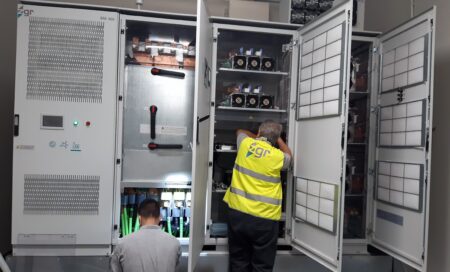
Service engineers operating a ZGR DVC SEPEC unit
What SEPEC is—and why it is not a conventional UPS
When addressing power quality issues in a plant, the first reference that comes to mind is a UPS. And that is not a bad reference: it makes sense to think about electrical backup. But there is an important difference between a UPS designed to protect servers in an IT room and a system designed for process continuity in an electro-intensive industrial environment.
The ZGR DVC SEPEC belongs to the latter category. It is a high-efficiency industrial UPS specifically developed for environments where production processes cannot afford even a moment of instability. It does not act as a simple backup for total outages: it operates as a permanent power conditioning barrier between the grid and the process equipment, correcting any disturbance in real time before it reaches the loads.
High-efficiency offline topology
This equipment includes several key features worth highlighting:
- Total efficiency > 99.5%
- Disturbances corrected: voltage sags, voltage variations and frequency fluctuations
- Generator set transfer: zero crossing does not occur; automation does not perceive the event
- Availability: designed for continuous 24/7 production
- Minimal maintenance
The integration with generator sets deserves special attention. In plants that rely on emergency generation to maintain continuity during grid failures, the transfer has always been a critical moment. SEPEC eliminates this risk point: the DC link and downstream supply to the loads never collapse during transfer, meaning automation does not register the event and processes continue uninterrupted.
A SEPEC coexists seamlessly with generator sets. The DC link and downstream supply to the loads never collapse during transfer.
This makes SEPEC qualitatively different from conventional electrical backup: it is a process continuity element, integrated into the production chain with the same design logic as a control system or a dosing line.
When the grid is “dirty”: the role of active harmonic filters
Protecting the plant from voltage sags addresses the most urgent issue. But in many cosmetic facilities there is a second front working more silently, with effects that appear over the medium term: harmonics.
The non-linear loads that characterize a modern plant—frequency drives, rectifiers, HVAC systems—generate current waveform distortion caused by non-linear loads. These distortions, harmonics, contaminate the internal grid and cause unexplained motor overheating, protection trips with no apparent cause, premature failures in power supplies, and a progressive reduction in the service life of the most sensitive electronic equipment.
The natural complement to SEPEC in these environments is the ZGR FAA/AHF active harmonic filter. With response times below 50 microseconds, it neutralizes harmonic pollution up to the 60th order and restores a near-sinusoidal current waveform to the internal distribution network. It also provides reactive power compensation and load balancing.
The combination of both systems—SEPEC for continuity, FAA/AHF for quality—offers comprehensive electrical protection from the point of common coupling (PCC) to the most precise laboratory equipment.
When continuous grid fluctuations are eliminated, equipment lifetime can increase by more than 30%
Real case: how a global fragrance supplier solved voltage sag and harmonic issues
A leading multinational in fragrances, aromas, nutrition and cosmetic ingredients detected that certain micro-interruptions and grid variations were repeatedly affecting its most sensitive mixing and distillation processes. The plant, located in Spain, operated in 24-hour cycles with high-precision automation and could not afford further batch losses or unplanned restarts.
“ZGR Corporación designed a dual protection architecture combining continuity and grid quality,” explains Jon Ander Beistegui, Director of the Industrial Business Unit at ZGR.
The solution proposed and installed consisted of ten SEPEC units to protect the main distribution bus from any voltage sag, and ten FAA/AHF active filters to eliminate harmonic pollution generated by the plant’s own loads.
ZGR installed 10 SEPEC units and 10 active harmonic filters, delivering a comprehensive solution to the company’s power quality challenges.
Results became visible within the first weeks of operation. Interruptions in critical processes disappeared. Automation stability improved noticeably, incidents associated with sensitive electronics were drastically reduced, and the KPIs that matter—OEE, product scrap, corrective maintenance interventions—showed sustained improvement.
Results achieved after implementing the comprehensive ZGR solution:
- Zero interruptions in critical mixing and distillation processes since installation.
- Improved OEE: direct reduction of unplanned stops and restart times.
- Less scrap: elimination of batches lost due to electrical instability.
- Maintenance: fewer corrective interventions on electronics and motors.
- GMP stability: cleanroom conditions maintained without interruption.
“It is a case that demonstrates how at ZGR Corporación we protect the entire customer value chain, from the point of energy entry to the most precise laboratory equipment,” highlights Jon Ander Beistegui.
Managing electrical energy as a process raw material
This case illustrates something that more and more industrial plants are beginning to assume: electrical energy can no longer be treated as a passive utility. In an automated and electro-intensive plant, power quality is as much a part of the process as formulation, mixing temperature, or product traceability.
Managing it with the same level of rigor as any other production variable is not a maintenance expense: it is a strategic decision reflected in operational KPIs, cost of non-quality, operational predictability, and ultimately the ability to meet the standards of the most demanding cosmetics manufacturing.
At ZGR Corporación, we have spent years working with industrial plants that have decided to stop accepting electrical disturbances as inevitable. Because your energy is our engineering challenge
Does your plant suffer from electrical-related stops or incidents?
The ZGR team can analyze your facility’s electrical exposure and size the right solution for your critical processes. No commitment required, backed by industrial technical criteria. We provide a free initial technical audit.
If you are interested, contact: industria@zigor.com
Y si quieres saber más sobre nuestras soluciones, puedes suscribirte a nuestro y sumarte a nuestra Comunidad de apasionados de la electrónica de potencia en
If you would like to learn more about our solutions, subscribe to our newsletter and join our community of power electronics enthusiasts on LinkedIn.
NOTE: Header image created using AI.


