


Prevention is better than a cure
In 1963, the measles vaccine revolutionized public health. We no longer wait for epidemics; we have vaccinated proactively ever since. The same principle applies to electrical engineering: when you understand the operational “DNA” of your equipment, you act before failures occur at scale. In industry jargon, we call these “epidemic failures,” and our goal is to eliminate them. Predictive maintenance through retrofitting prevents the “epidemic failures” that can bring plants to a halt.
“If you don’t have enough data, you are always reacting too late,” explains Pablo Aranda, Electronics Engineer at ZGR and specialist in maintenance and after-sales service. “You begin to see an epidemic failure—a common fault affecting many units simultaneously—when it is already too late and response capacity is limited. Retrofitting allows you to eliminate the root cause through predictive maintenance. And this is something our customers are highly interested in.”
The “bathtub curve”: anticipating electrical aging
All electronic equipment follows a predictable reliability pattern known as the “Bathtub Curve,” with three distinct phases:
- Decreasing failure rate (approx. 0–2 years): Where manufacturing defects, installation issues, and initial testing problems emerge and are quickly rectified.
- Constant failure rate (approx. 2–10 years): Characterized by maximum equipment availability and random, sporadic failures.
- Increasing failure rate (from 10–15 years onward): When components most exposed to daily operational stress begin inevitable degradation as they approach the end of their design life under warranty.
It is in this final phase where failures become epidemic: when one component fails in a system, identical components in other units often follow—triggering a chain reaction that can result in production shutdowns and severe operational crises.
Understanding the exact point on this curve for each component or system marks the difference between a planned partial shutdown of a few hours or days for component replacement, and a major crisis lasting weeks or months with full production stoppage.
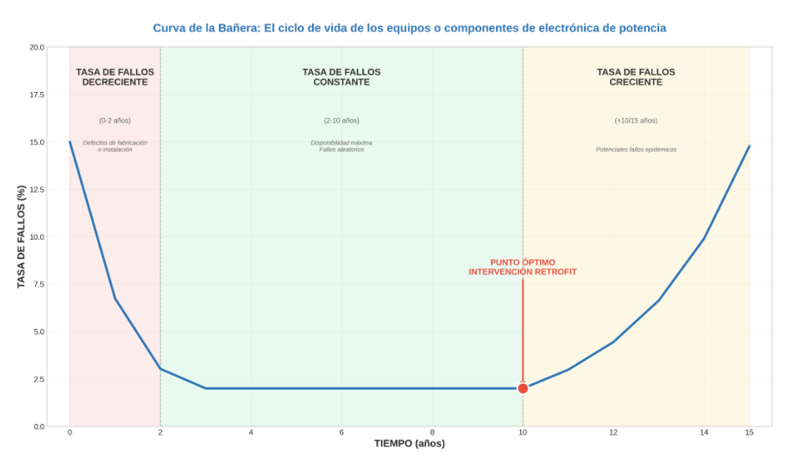
La “curva de la bañera” es una herramienta de gestión utilizada en los servicios de mantenimiento predictivo de retrofit de equipos o componentes de electrónica de potencia. | EN The ‘Bathtub Curve’ is a management tool used in predictive retrofit maintenance services for power electronics equipment and components.
Data that anticipates the future
Predictive maintenance outperforms both corrective and preventive strategies. It analyzes real-world operational data—temperature, current, and voltage—to determine exactly when an asset will fail.
“We know the nominal service life of each component; we understand actual wear through daily monitoring and systematic preventive maintenance data; we analyze the position on the Bathtub Curve; we identify ‘epidemic’ components early, and we act proactively, replacing critical elements before failure,” explains Pablo Aranda.
This methodology transforms data into decisions, implemented through retrofitting. Anticipating the end-of-life of components and planning replacements in advance avoids forced decisions and potential operational disruptions.
Retrofit: strategy and modalities
Continuing the medical analogy, retrofitting adopts different “therapeutic” approaches depending on the diagnosis:
- Component retrofit: Replaces components at the end of their service life before catastrophic failure occurs. It could be described as “selective surgery.” For example, replacing aging transformers or protection systems without modifying the structure or modules of a solar inverter in a PV plant.
- Design retrofit and functional improvements: Incorporates technological enhancements when analysis reveals failures due to suboptimal design. In this case, we are looking at a “functional implant” or “personalized medicine”; the choice depends on the clinical history and varies in each case. An example of this is expanding control sensor arrays in inverter components to improve the data quality obtained during operation and maintenance (O&M).
In both types, the objective is the same: prevent end-of-life failures, avoid unexpected shutdowns, and extend equipment lifespan without the financial burden of a full replacement.
ZGR retrofit success story: Kaixo Solar (Chihuahua, Mexico)
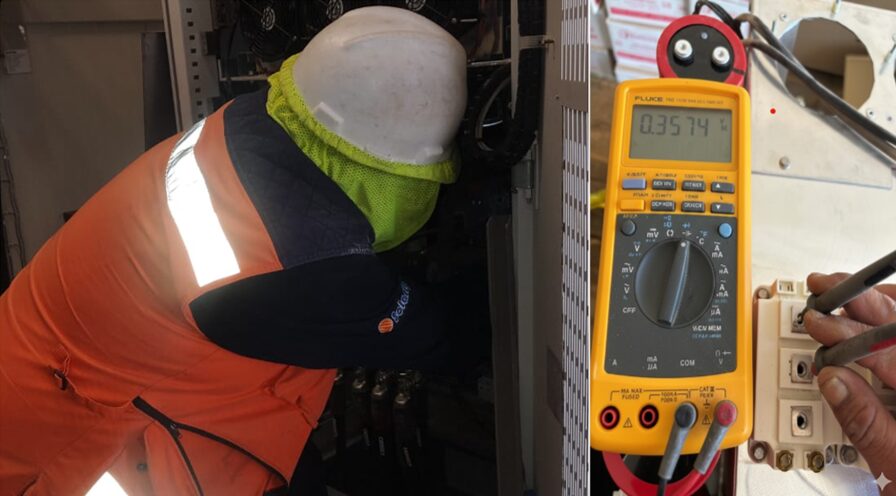
Operario de ZGR en la planta fotovoltaica de Kaixo. Medición técnica de un equipo de electrónica de potencia. Servicio retrofit. | EN ZGR technician at the Kaixo PV plant. Technical measurement of power electronics equipment. Retrofit service.
The project by ZGR Corporación at the Kaixo Solar photovoltaic plant (located in Ascensión, Chihuahua, Mexico) is one of the company’s most significant milestones in the Latin American market. In 2018, ZGR acted as the key technology partner, responsible for the supply of power electronics. Specifically, it provided:
- Supply of 54 MW in solar inverters: These units are the “brain” of the plant, responsible for converting solar energy into grid-compatible electricity.
- Adapted technology: ZGR inverters were selected for their ability to operate stably in environments with complex or “weak” power grids, a common characteristic in remote areas of Mexico.
The plant, with an installed capacity of approximately 65 MWp, features over 204,000 photovoltaic panels distributed across 200 hectares, with an annual production of nearly 165 GWh—equivalent to the consumption of approximately 120,000 Mexican households.
Now, in 2026, certain inverter components—which for years have operated at maximum capacity for an average of 14–15 hours daily under extreme desert conditions (high temperatures and heavy dust in Chihuahua)—have entered the wear and degradation phase. Therefore, a predictive technical retrofit service is being performed on capacitors and other critical components.
As a result, Kaixo Solar extends the service life of its equipment, avoids full plant shutdowns, and maintains the peak productivity and profitability levels it currently enjoys.
Strategic value: comprehensive asset lifecycle management
“Retrofit is the difference between amortizing a plant in 10 years or 15,” explains Odilo Alonso, Head of Technical Service at ZGR Corporación.
“Our customers do not want to replace infrastructure that is still working. They want to monetize every euro invested, reduce production costs, adapt to new regulations, and prepare their assets for new business models—such as storage or grid services—without massive capital expenditures,” highlights Alonso.
“En ZGR les podemos ayudar, porque tenemos la tecnología más avanzada que no existía cuando sus plantas se construyeron, pero, además, contamos con un servicio técnico local y altamente especializado que entiende mejor que nadie su caso y cuál es el tipo de retrofit más adecuado para sus activos”, apunta por su parte Pablo Aranda, especialista en el servicio post-venta.
“At ZGR, we can help them because we have the advanced technology that did not exist when their plants were built. Furthermore, we provide a highly specialized local technical service that understands their specific case better than anyone,” adds Pablo Aranda.
“A properly executed retrofit extends equipment lifespan by five to fifteen years”
A properly executed retrofit extends service life by an average of five to fifteen years, depending on the case, eliminates unscheduled downtime, and avoids unforeseen investments due to equipment failure. Crucially: it incorporates functionalities that were non-existent in the original design. It is not “repairing to stay the same,” but evolving without rebuilding from scratch.
The ZGR Technical Service advantage: data, expertise, and proximity
ZGR delivers predictive retrofitting with guarantees based on three pillars:
- Technological DNA Knowledge: ZGR manufactures, commissions, and maintains the historical lifecycle data of its equipment. It knows every component, design, and firmware. This traceability allows for the exact prediction of when and how a component or system will fail.
- Local & Global Service: Operational presence in Spain, Mexico, Colombia, and the US guarantees response times under 48–72 hours in regions with an active delegation.
- Modularity & Compatibility: ZGR has long championed modular design, allowing for the update or replacement of modules and components without requiring a total shutdown of the asset.
Predictive maintenance with retrofitting is an increasingly demanded operational reality. It is the difference between managing assets reactively or proactively—anticipating needs and maximizing returns.
Predictive maintenance with retrofitting is an increasingly demanded operational reality
Just as we vaccinate to avoid epidemics, retrofitting prevents epidemic failures. The “Bathtub Curve” is a management tool, and data helps us make informed, objective decisions. Thanks to this and the know-how of our after-sales team, aging equipment is transformed into rejuvenated assets with additional years of productivity.
Is your PV plant over 8 years old? Do your critical assets exceed 50,000 operating hours? Are your infrastructures facing new regulatory requirements?
ZGR aporta experiencia de tres décadas de trabajo de campo en el mantenimiento de equipos de electrónica de potencia, fabricación en España y servicio técnico propio. No esperes a la crisis.
ZGR brings three decades of field experience in power electronics maintenance, manufacturing in Spain, and proprietary technical service. Don’t wait for the crisis.
Contact ZGR’s After-Sales Service and discover how predictive retrofit extends lifespan, prevents downtime, and maximizes your return on investment.
At ZGR, we support you from the initial technical authorship, custom design and manufacturing, installation and commissioning, to subsequent 24/7/360 maintenance—and throughout the equipment’s entire service life. With retrofit, even beyond.
Your energy, our challenge.


