


Why the PCS is the heart of energy storage systems
The accelerated growth of energy storage is transforming the architecture of utility-scale renewable plants. In this new energy ecosystem, BESS have become a strategic asset for grid stabilization, renewable production optimization, and participation in ancillary services markets.
In this context, the PCS becomes the technological cornerstone that largely determines the efficiency, reliability, and economic performance of the entire BESS. The PCS acts as the intelligent interface between the battery system and the electrical grid, managing bidirectional conversion between direct current (DC) and alternating current (AC), controlling energy flow, and ensuring the system’s operational stability.
In large-scale plants, where projects easily exceed tens or hundreds of megawatts, the choice of power conversion architecture becomes a critical decision for investors, developers, and EPCs. The dominant trend in these projects is the use of 1500 V BESS architectures, which maximize system efficiency and reduce electrical infrastructure costs.
It is precisely in this segment where companies such as ZGR Corporación have developed power electronics solutions specifically designed for utility-scale applications, with equipment such as the ZGR PCS 3000 kW and the ZGR PCS 4500 kW, engineered to operate in demanding environments and maximize system availability throughout the project’s lifetime.
Why 1500 V BESS systems have become the utility-scale standard
The 1500 V DC architecture has become firmly established in recent years as the standard for large-scale renewable plants and energy storage systems. This evolution follows a clear technical and economic rationale well known in power electronics design: increasing system voltage allows higher power transfer with lower current, reducing losses and optimizing the sizing of electrical components.
In large-scale storage projects, this architecture reduces energy losses, decreases the number of cables and protection devices, simplifies electrical infrastructure, and improves overall system efficiency.
The result is a significant reduction in the system’s LCOE (Levelized Cost of Energy), a key factor for projects operating under tightly constrained financial models, as it measures the total cost of producing and managing energy throughout the installation’s lifetime.
For this reason, PCS specifically designed for 1500 V BESS have become the dominant solution in utility-scale energy storage projects, especially in applications such as:
- Solar + storage hybridization
- Grid stabilization
- Energy arbitrage
- Frequency regulation services
PCS specifically designed for 1500 V systems are the dominant solution for utility-scale energy storage projects.
Although the 1500 V architecture currently dominates the utility-scale storage market, the sector is already beginning to evolve toward 2000 V architectures. The goal of this technological step is to continue optimizing costs and system efficiency by enabling even higher power transfer at lower current levels.
Aware of this market evolution, the innovation center at ZGR Corporación is already preparing technological developments and 2000 V architectures, anticipating future demands of large energy storage projects.
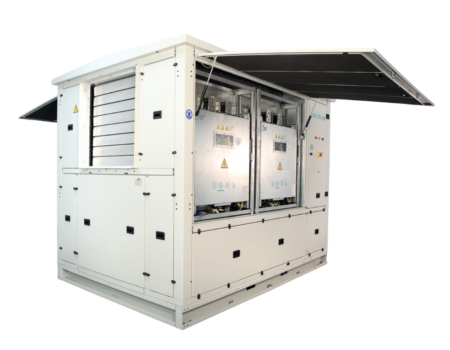
ZGR PCS 3000 kW / PCS 4500 kW: power electronics designed for utility-scale storage
Within this technological context, the ZGR PCS 3000 kW and ZGR PCS 4500 kW converters have been specifically designed to meet the requirements of large-scale storage projects.
Both PCS units share the same technological architecture, components, and design philosophy, differing only in power capacity. This design strategy simplifies operation and maintenance in large projects, where component standardization is key to optimizing operational costs.
Both systems are characterized by three attributes that define the design philosophy of ZGR’s power electronics:
ZGR philosophy: high reliability, operational flexibility, and productivity.
Estas características son especialmente relevantes en proyectos utility-scale, donde la disponibilidad del sistema y la capacidad de adaptación a diferentes configuraciones de planta son factores determinantes para la rentabilidad de la inversión. Gracias a su arquitectura modular, ambos PCS pueden configurarse y adaptarse a las necesidades específicas de cada proyecto, permitiendo a desarrolladores y EPCs optimizar la integración del sistema de almacenamiento dentro de cada planta.
These PCS features are particularly relevant in utility-scale projects, where system availability and adaptability to different plant configurations are decisive factors for investment profitability. Thanks to their modular architecture, both PCS units can be configured and adapted to the specific needs of each project, enabling developers and EPCs to optimize storage system integration within each plant.
Designed for extreme environmental conditions
One of the major challenges in utility-scale storage projects is operation in highly demanding environmental conditions. Many plants are deployed in regions with extreme temperatures, high dust concentration, or harsh climatic conditions.
For this reason, both the ZGR PCS 3000 kW and the ZGR PCS 4500 kW have been designed to operate reliably under severe environmental conditions, maintaining performance and availability even in high-temperature environments (full power without derating up to 50 °C, maximum 60 °C).
This capability is a key factor for projects located in markets with vast desert regions or extreme continental climates such as the United States, Canada, Latin America (Mexico, Chile, Colombia), and several European regions including Spain, Italy, and other EU countries, where the company has its main customers and projects.
Industrial air cooling: a distinctive advantage
One of the most distinctive features of the PCS developed by ZGR Corporación is its industrial air-cooling concept specifically engineered for high-power PCS applications (Electronic Free Industrial Cooling System; Clean Air Electronic Cabinet), a solution addressing one of the main concerns in large-scale power electronics systems: thermal management.
While many converters use liquid cooling systems, ZGR’s approach relies on an industrial-grade air cooling design optimized for utility-scale applications.
This approach provides several key advantages:
- Reduced system complexity
- Lower maintenance requirements
- Greater operational robustness
- Elimination of risks associated with coolant leaks
- Higher long-term reliability
For investors and plant operators, these characteristics translate directly into lower operation and maintenance costs over the project lifetime.
Synergies with the ZGR CTR range: simplified operation and maintenance
Another strategic advantage of the technological architecture of these PCS units is that they share the same design base and components as the ZGR CTR 3000 kW and ZGR CTR 4500 kW systems.
This technological convergence allows projects that combine different power conversion solutions within the same plant to benefit from component, architecture, and maintenance standardization.
For utility-scale plant operators, this means a significant simplification of spare parts inventory, reduced maintenance costs, and faster service operations. In large-scale projects, where every operational decision impacts the total system cost, these technological synergies provide a significant competitive advantage.
The PCS as a strategic element in BESS profitability
In utility-scale BESS projects, selecting the right PCS is not only a technical decision. It is a strategic decision that directly impacts energy efficiency, system reliability, and the plant’s total cost of operation.
Solutions such as the ZGR PCS 3000 kW and the ZGR PCS 4500 kW, specifically designed for 1500 V systems, enable developers, investors, and plant operators to deploy highly reliable, efficient storage systems ready to operate in the most demanding environments.
Thanks to their modular PCS architecture, industrial robustness, and optimized cooling system, these converters are particularly well suited for large-scale energy storage projects aiming to maximize performance over decades of operation.
Technical conclusions for BESS storage projects
When designing or evaluating a utility-scale energy storage system, developers, engineering firms, and investment managers typically consider several key questions:
What role does the PCS play inside a 1500 V BESS?
The PCS connects the battery system to the electrical grid and manages bidirectional energy conversion between DC and AC. Its design largely determines overall system efficiency, operational stability, and the ability to participate in grid services.
Why does the 1500 V PCS architecture currently dominate utility-scale BESS?
1500 V systems allow higher power transfer with lower current, reducing energy losses, simplifying electrical infrastructure, and improving system efficiency. This is why it has become the standard for large storage projects.
What is the difference between a conventional inverter and a PCS for energy storage?
While an inverter is optimized to convert energy generated by renewable sources to the grid, a PCS is designed for bidirectional operation, enabling both charging and discharging of the battery system.
What power ratings are typical for PCS in utility-scale projects?
In large-scale storage projects, it is common to work with multi-megawatt converters. Solutions such as the ZGR PCS 3000 kW and the ZGR PCS 4500 kW help optimize plant architecture, reduce integration complexity, and maximize system efficiency.
How will BESS system voltage evolve?
Although 1500 V is the current standard, the sector is already exploring 2000 V architectures, which will increase power density and further reduce costs in large-scale storage projects.
At ZGR, your energy is our challenge.
Contact our team to learn about the customized solution for your project.
And if you are passionate about power electronics and want to stay up to date, join our LinkedIn Community. We share product updates, technical articles, and success stories in our newsletter.


